
Bills of Materials (BOM)
Where it all comes together
Español: Lee esta página en español.
Français : Consultez cette page en français.
This page applies to DataNinja tenants integrated with NetSuite or QuickBooks Online, and to tenants with no finance system integration. The workflow in DataNinja is the same across integrations; where a financial system changes behavior, the integration-specific note calls it out.
Items that are synced with an integration will show the relevant integration's logo. Screenshots on this page may show the NetSuite logo, but tenants integrated with QuickBooks Online will see that logo instead. Tenants with no financial integration won't see any logo.
Anything you want to track inventory of needs a part number. The part number uniquely identifies what the inventory item is, while the BOM tracks the "recipe" for how to make the inventory, if a particular part is generated via the consumption of other parts (like a Finished Good or Sub-Assembly).
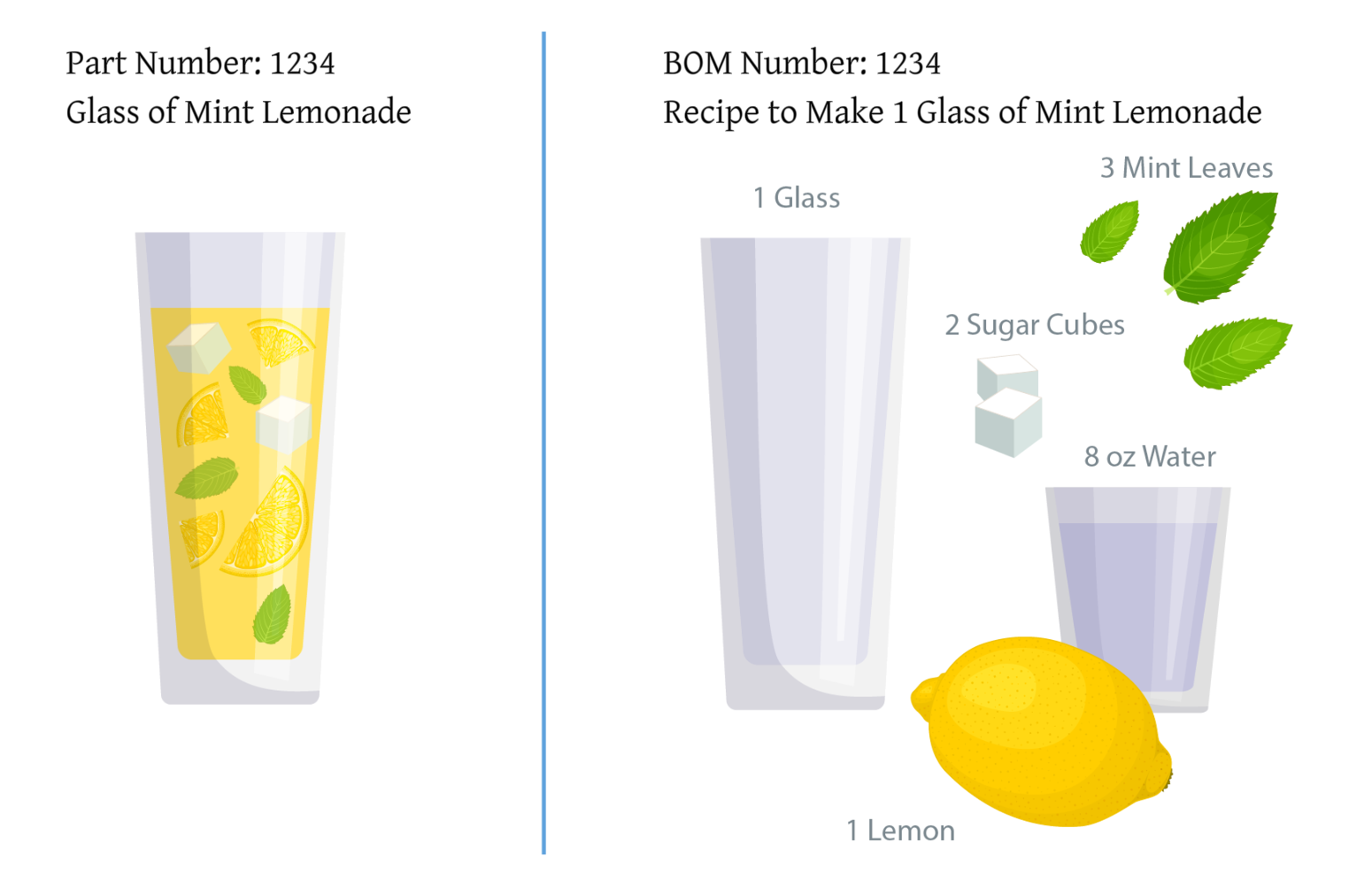
The BOM is where you map your manufacturing process in DataNinja so that you can control how ingredients come together to produce inventory of a product.
A DataNinja BOM contains:
- Configuration
- Required parts
- Attributes (customizable data collection and verification web-form building blocks)
- Sampling (AQL)
- Approvals
- Equipment
LingoDepending on your business processes, one or more of the following terms may be synonymous with what DataNinja means when referring to a BOM: Recipe, Formulation, Routing, MMR etc.
QuickBooks Online
All BOMs should be created in DataNinja.
NetSuite
As of DN version 4.21.264.490, where you create BOMs depends on the "Sync BOMs" setting. To find it, click on the gear icon, go to Company Settings, then "Finance", and look in the NetSuite section. It's set to No by default.
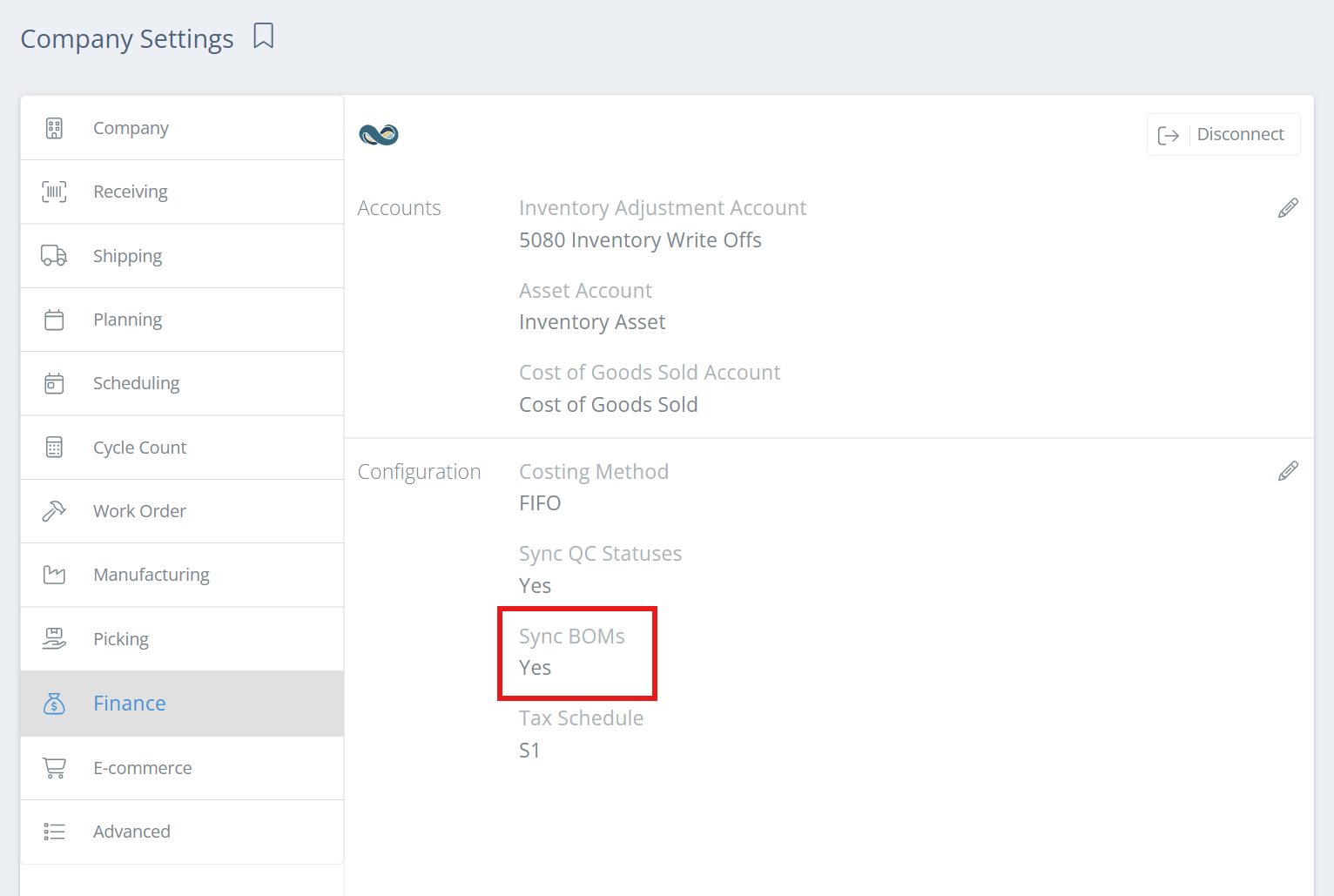
- Sync BOMs set to No – Create BOMs in NetSuite first, then sync them to DataNinja. Once the BOM is available in DataNinja, you can manage process steps, AQL, and approvals within DataNinja.
- Sync BOMs set to Yes – Create BOMs in DataNinja. When you release a BOM, DataNinja pushes it to NetSuite. BOM imports from NetSuite are skipped while this setting is on, so make BOM changes in DataNinja rather than in NetSuite.
When DataNinja pushes a BOM, the name in NetSuite includes the BOM version, so each version shows up as its own BOM in NetSuite. The produced part must be an assembly in NetSuite, and DataNinja won't let you create or release a BOM for a part that can't be manufactured.
If you use NetSuite MRP or NetSuite-native manufacturing transactions, NetSuite must remain the source of truth for materials consumed during production.
If your DataNinja site is on a version prior to 4.21.264.490, then BOMs should be created in NetSuite, and new versions of a BOM can be created in DataNinja.
Creating a BOM in DataNinja
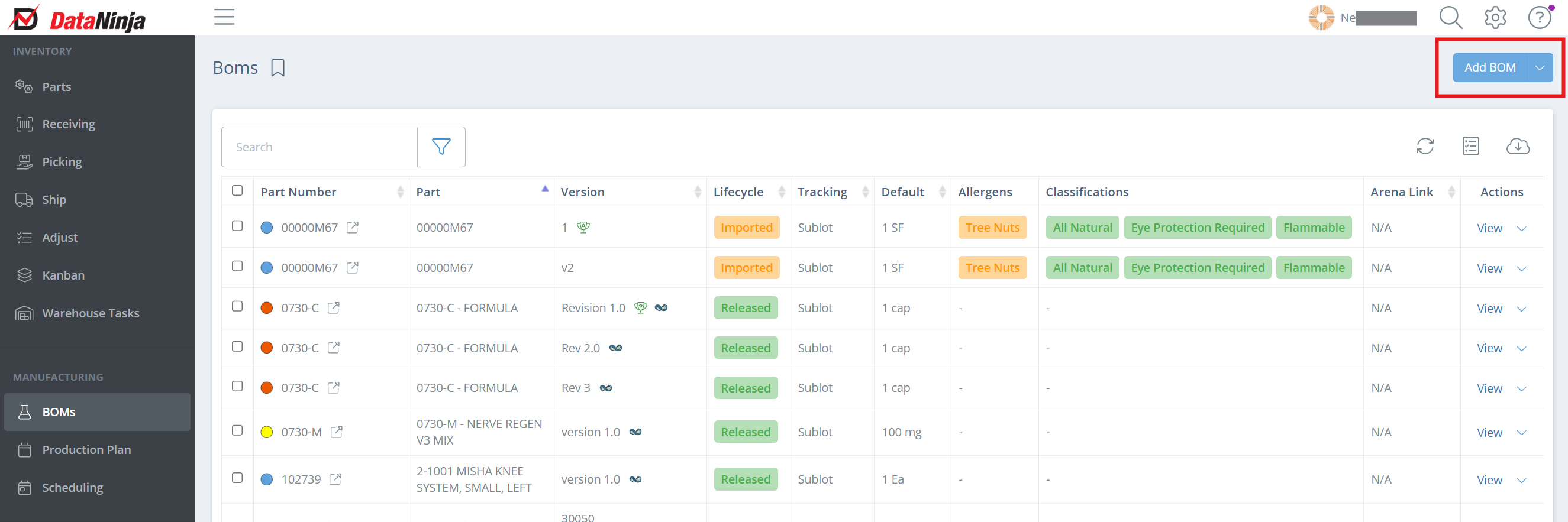
To create a new Bill of Materials, click on the "BOMs" tab in the left-hand sidebar, then click "Add BOM" in the top right.
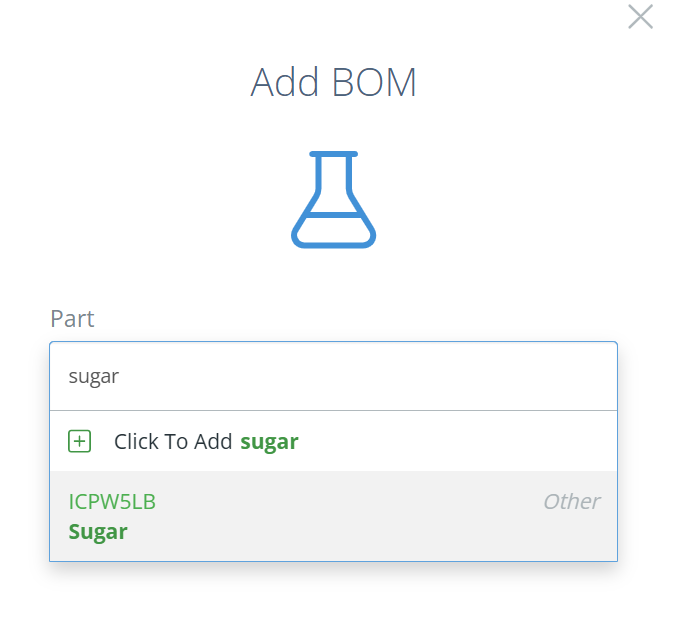
In the new aside, select the part that will be produced when this BOM is scheduled. The part should be either a Finished Good or a Sub-Assembly.
The Manufacturing Part Class field is an organizational strata for reporting purposes (e.g., Capsules, Stick Pack, etc.). If you don't have any Manufacturing Part Classes set up yet, you can add one by typing the name in the field and clicking Add, or leave it as Other.
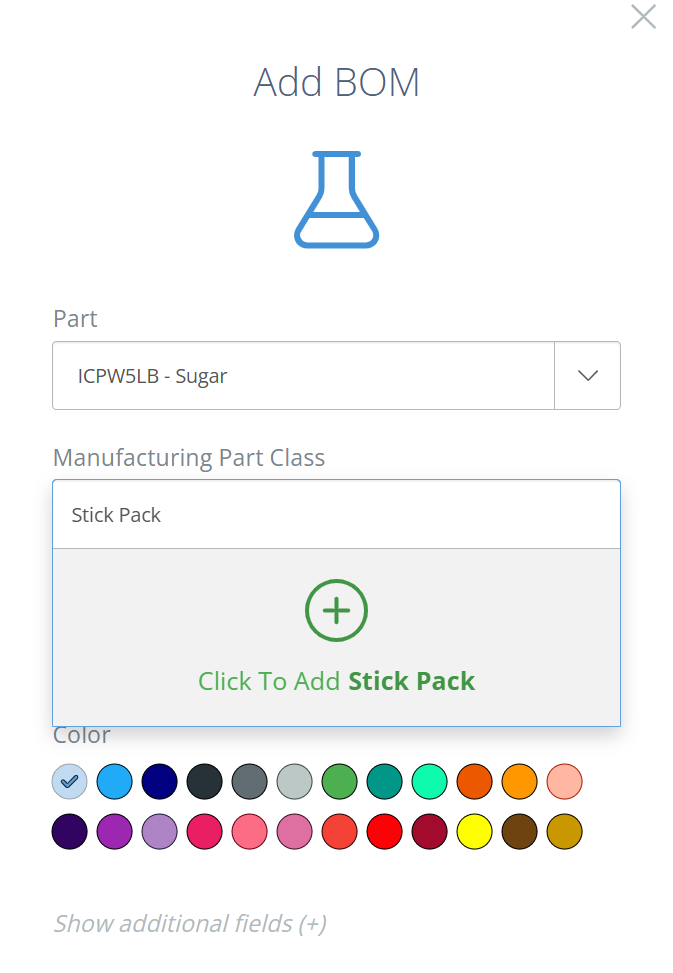
The Version is the unique variant of the BOM, for traceability purposes. Once a BOM has at least 1 scheduled manufacturing run associated with it, it can no longer be modified and a copy of the BOM (with a new version number) must be created. Having multiple versions of a BOM also allows flexibility if there is more than one valid way to produce inventory of the BOM Part Number. For simplicity, start with version 1 or 1.0.
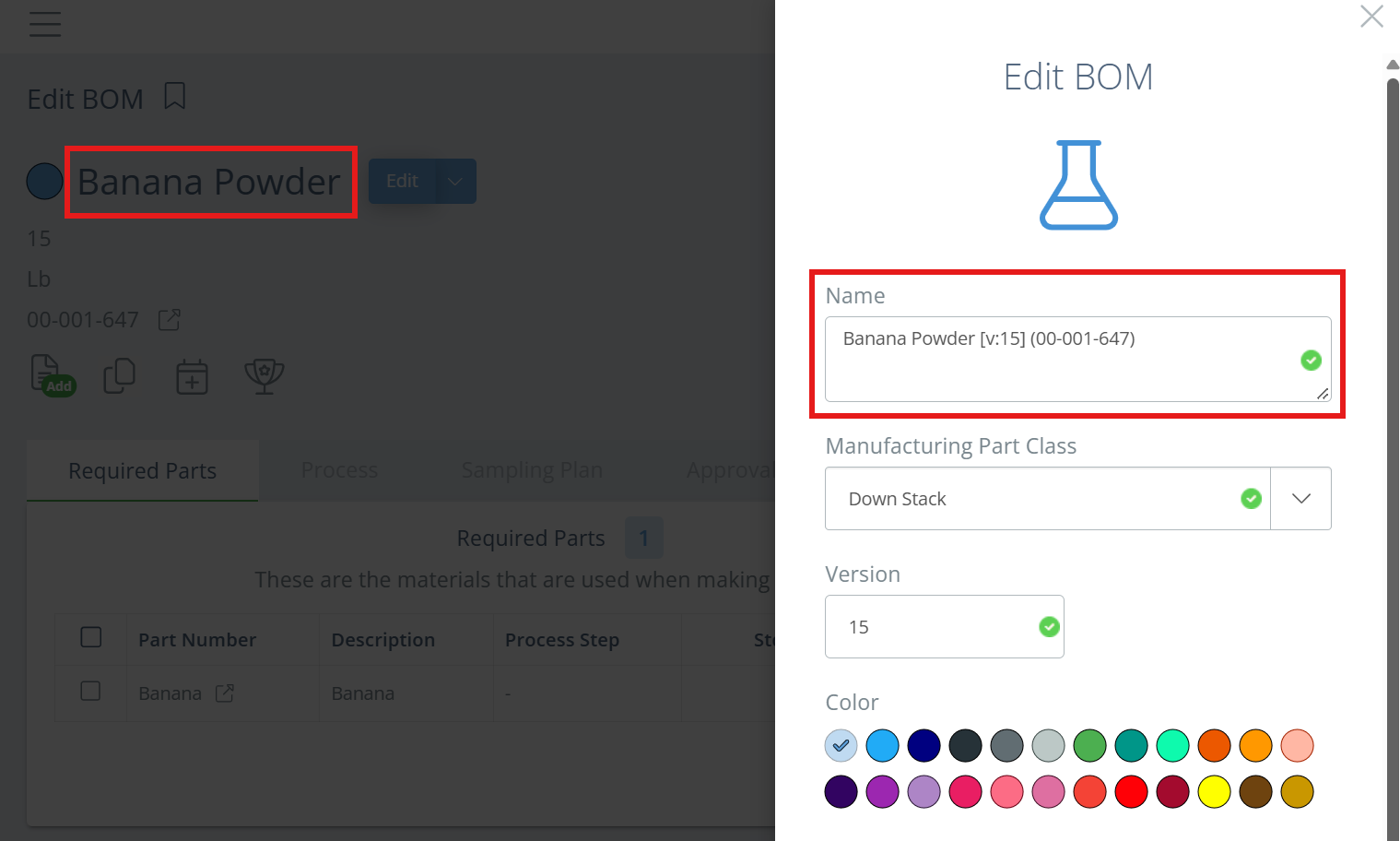
BOM NameDataNinja builds the BOM name from the part name, the version, and the part number, such as "Blue Widget [v:2] (FG-100)". NetSuite requires that BOM names be globally unique, so each version of a BOM now gets a new name. However, for simplicity, in the DataNinja UI the BOM name will still show as the name of the produced part. The globally unique BOM name will only show in DataNinja in the Edit BOM aside.
Once the version field has been filled, select a color for the BOM. Selecting a color can help with categorizing, but you can also leave all BOMs the same color.
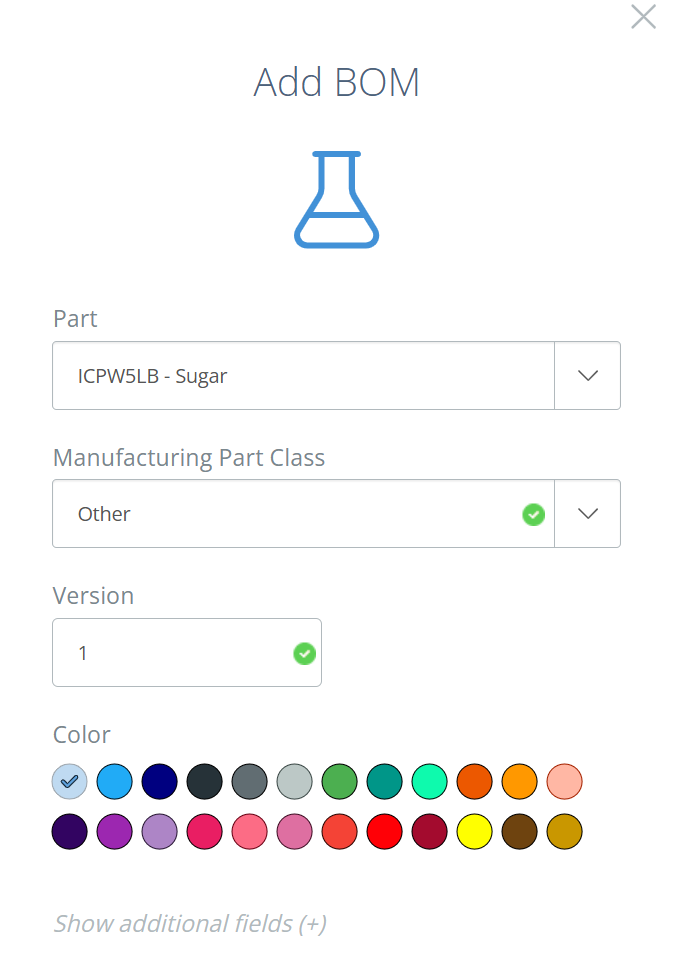
Additional Fields on BOMs
By clicking "Show additional fields (+)" when creating/editing a BOM, you can specify some additional settings.
Default Batch Size
This specifies the default quantity to produce when the BOM is being schedule for production. The standard default is 1, but if following this BOM will typically create a greater or lesser quantity of the part, then adjust the number accordingly. This field uses the same Unit of Measure (UOM) as the part.
Minimum Quantity
This specifies the minimum quantity that you can schedule to be produced. The standard default is 1, but if the Default Batch Size is greater than 1, you can adjust the Minimum Quantity to be greater than 1, so long as it is less than or equal to the Default Batch Size. This field uses the same Unit of Measure (UOM) as the part.
Maximum Quantity
This specifies the maximum quantity that you can schedule to be produced per batch. The standard default is 1000, but can be adjusted as long as it is greater than or equal to the Default Batch Size. This field uses the same Unit of Measure (UOM) as the part.
Location
The standard default is the location associated with the part. This is where inventory will be produced into once the BOM is used in production.
Customer
If this part is going to be sold or shipped directly to a specific customer, you can select which customer in this field, or leave it blank.
Variance
The standard default variance is between 90 and 110 percent. Going above the maximum or under the minimum will trigger an escalation. The percent is based on the scheduled quantity, per batch. You can adjust both the upper and lower limits, if you need to be more or less strict about the amount produced in an order.
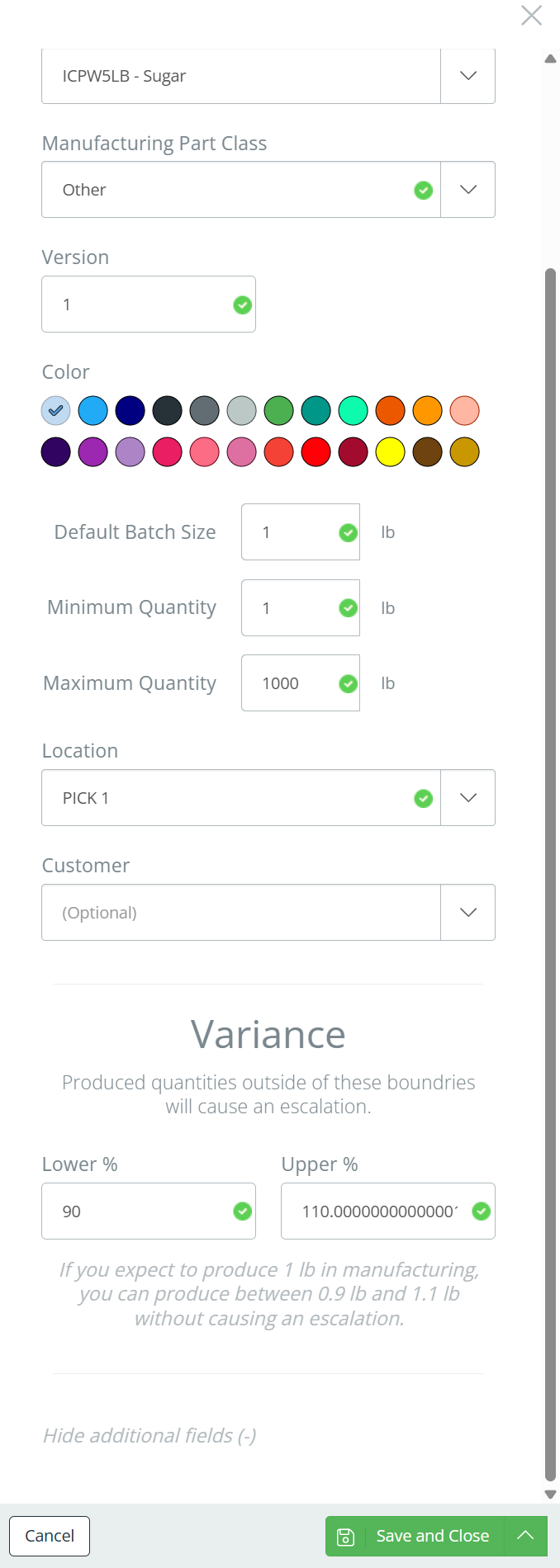
Click "Save and Close" when all changes have been made.
Copy a BOM
Copying a BOM makes BOM edits easier, as you don't have to start from scratch to create a new BOM. It's also helpful when multiple parts have similar manufacturing processes or consume similar parts, since you can copy required parts and process steps to a BOM that produces a completely different part. BOMs in any status can be copied.
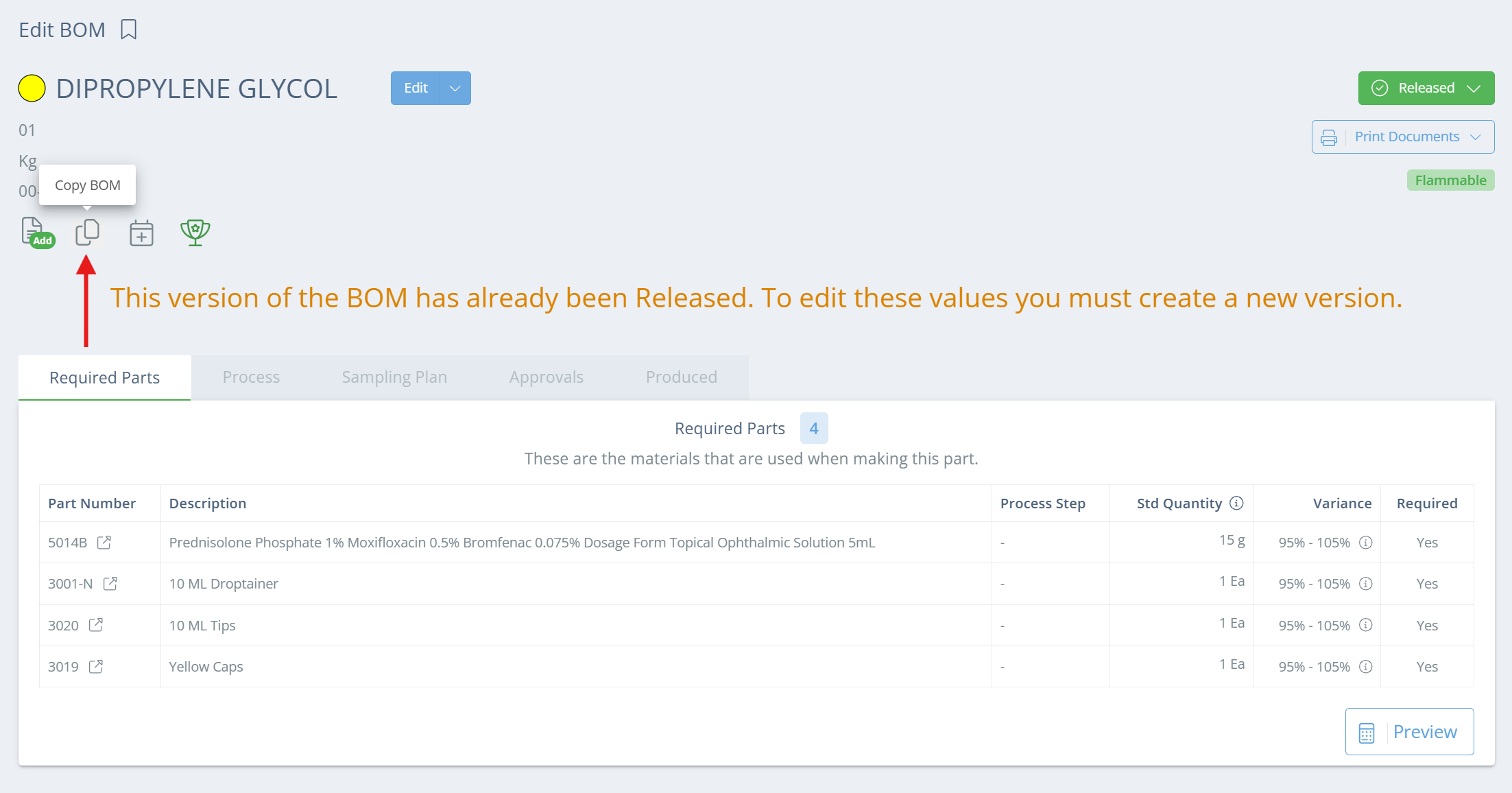
To copy a BOM, click on the BOMs tab and open the relevant BOM. Below the BOM name on the Edit BOM page, find the copy icon and click on it.
In the dropdown that appears choose from one of the three copy options.
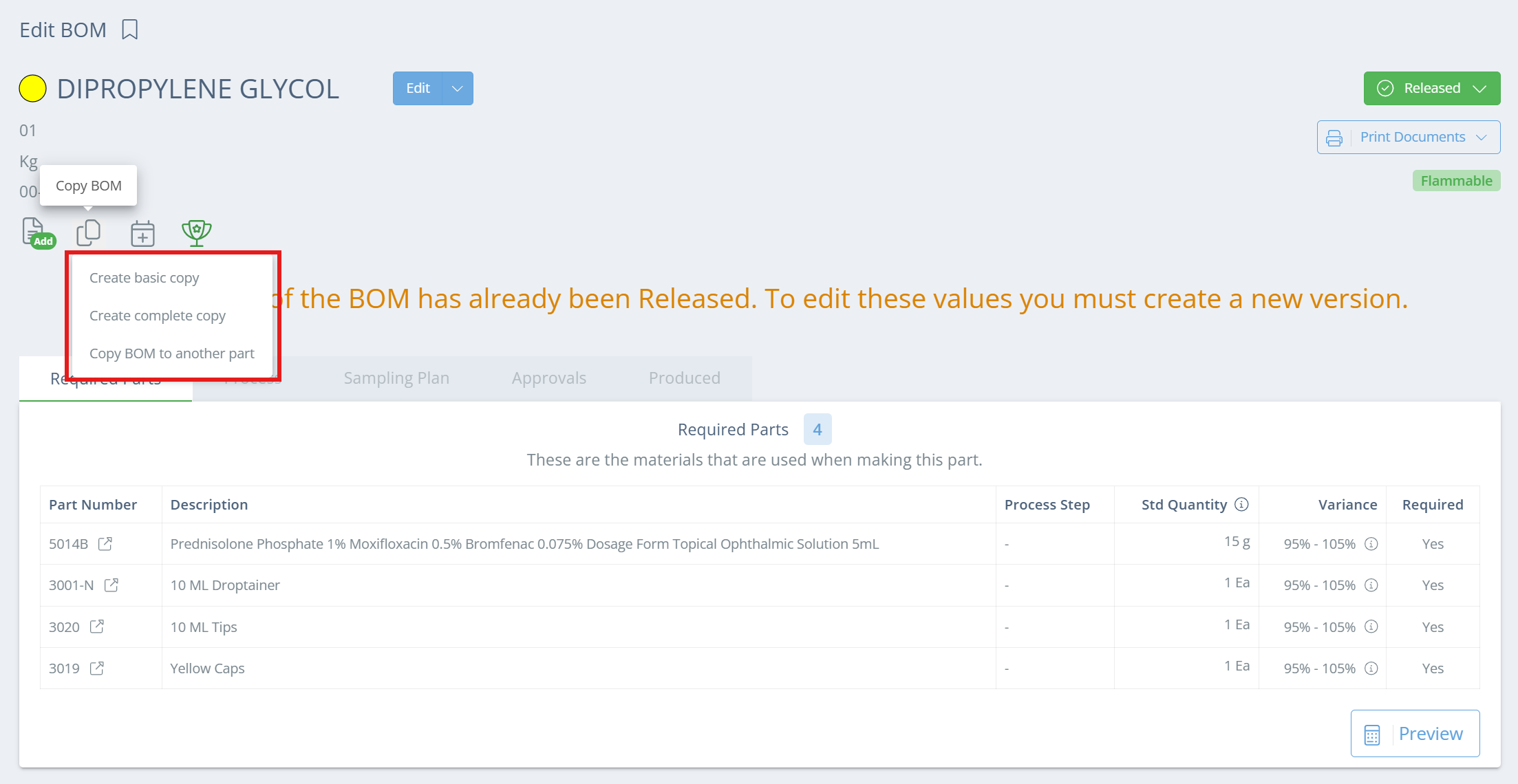
| Copy Type | What the Copy Does | Next Required Step |
|---|---|---|
| Create basic copy | Copies only the produced part | Enter new version number |
| Create complete copy | Creates an identical copy of current BOM, under different version | Enter new version number |
| Copy BOM to another part | Creates an identical copy of current BOM, but the produced part is different | Select new produced part, enter new version number |
"Copy BOM to another part" only works when the new produced part is lot or serial tracked. You can't copy a BOM to a part with a Tracking Type of Part.
Make any needed changes to the BOM, then change the Lifecycle (status) to Released so the BOM can be scheduled for production.
Discontinue a BOMIf the BOM you copy from will be obsolete after your updates to the new version, it's a good idea to set the Lifecycle of the old BOM version to Discontinued. That way the production team can't accidentally select the old version when scheduling, but the version will still exist for traceability.
Updated 4 days ago