
Required Parts
Adding required parts to a bill of materials (BOM)
Español: Lee esta página en español.
Français : Consultez cette page en français.
This page applies to DataNinja tenants integrated with NetSuite or QuickBooks Online, and to tenants with no finance system integration. The workflow in DataNinja is the same across integrations; where a financial system changes behavior, the integration-specific note calls it out.
Items that are synced with an integration will show the relevant integration's logo. Screenshots on this page may show the NetSuite logo, but tenants integrated with QuickBooks Online will see that logo instead. Tenants with no financial integration won't see any logo.
Required parts are the ingredients of a BOM- the parts that are consumed to produce inventory of the finished product when the BOM is used in a production run.
Add a Required Part
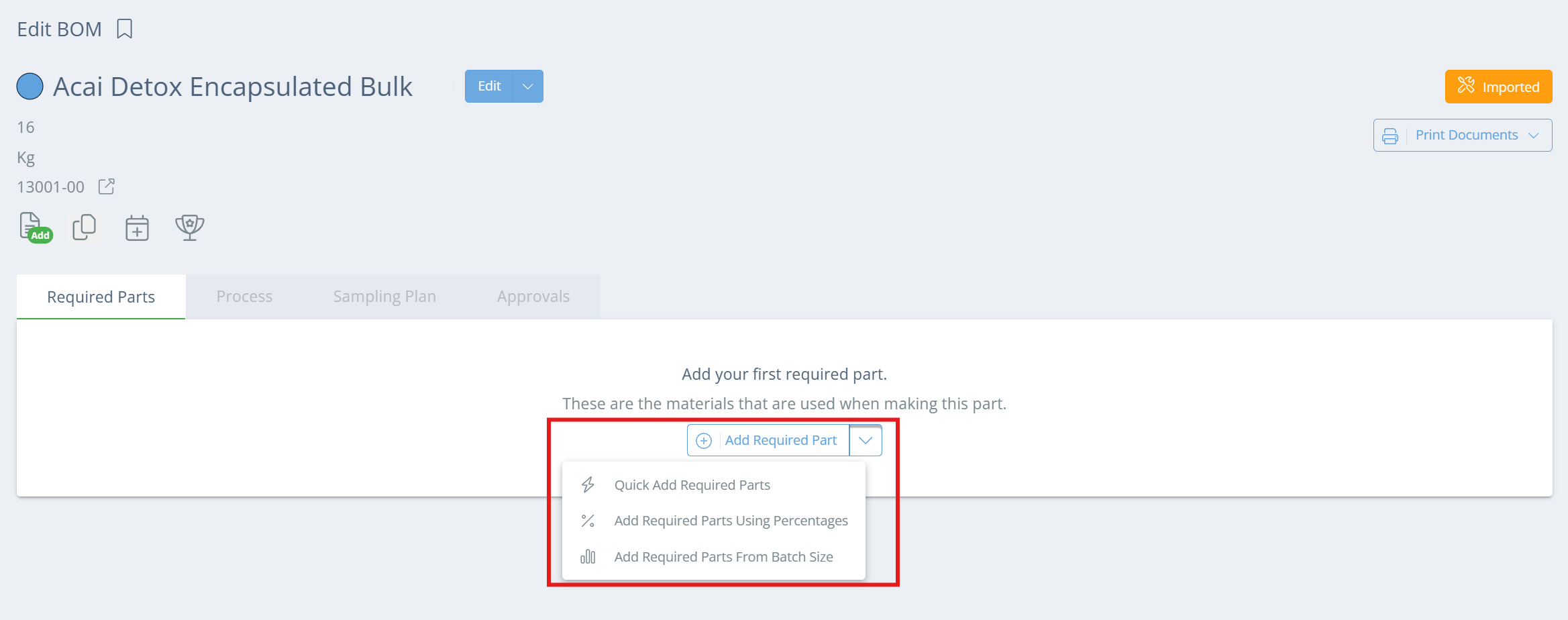
From the left-hand side bar click on 'BOMs', then click 'View' in the Actions column, or double click on a part to open the BOM you will be adding parts to. From the Edit BOM page under the Required Parts tab, click 'Add a required part'; or choose a different option from the dropdown.
Getting Standard Quantity RightIf your ingredient is tracked in kg, and the part produced by the BOM is tracked by the Case; the standard quantity of the ingredient should the amount (in kg) that goes into 1 Case of the produced part.
See Units of Measure
Via 'Add Required Part'
This method adds parts one at a time, and can potentially be time-consuming if there are a lot of required parts.
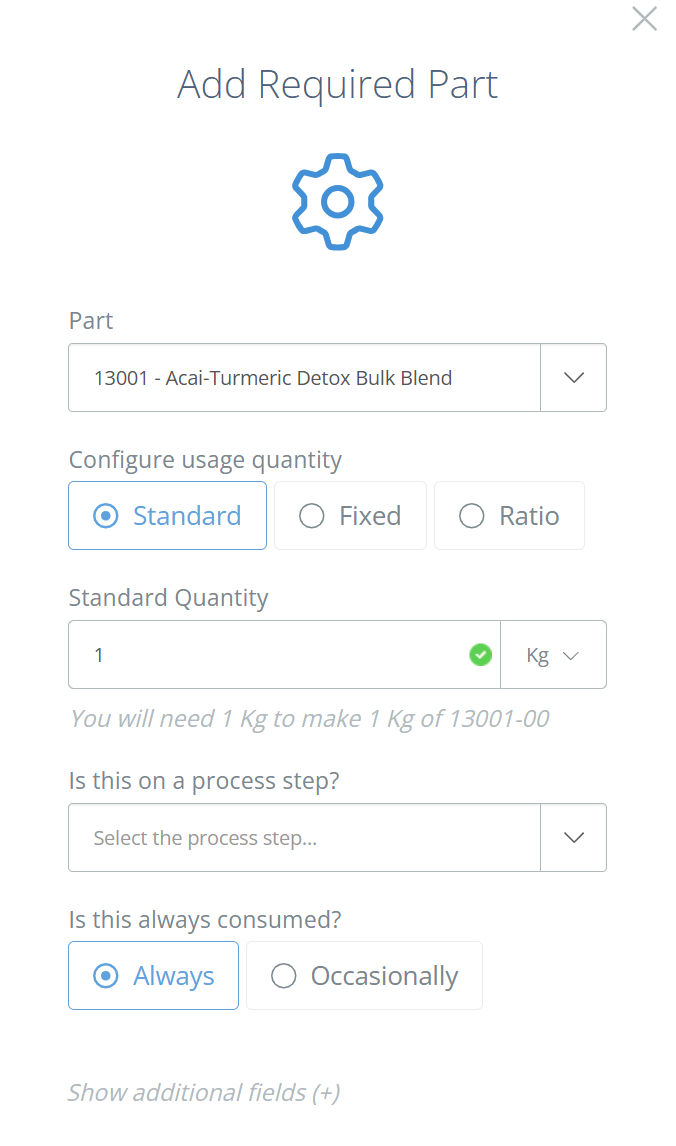
Once you click 'Add Required Part', a new aside will open. Select the part that will be consumed during manufacturing.
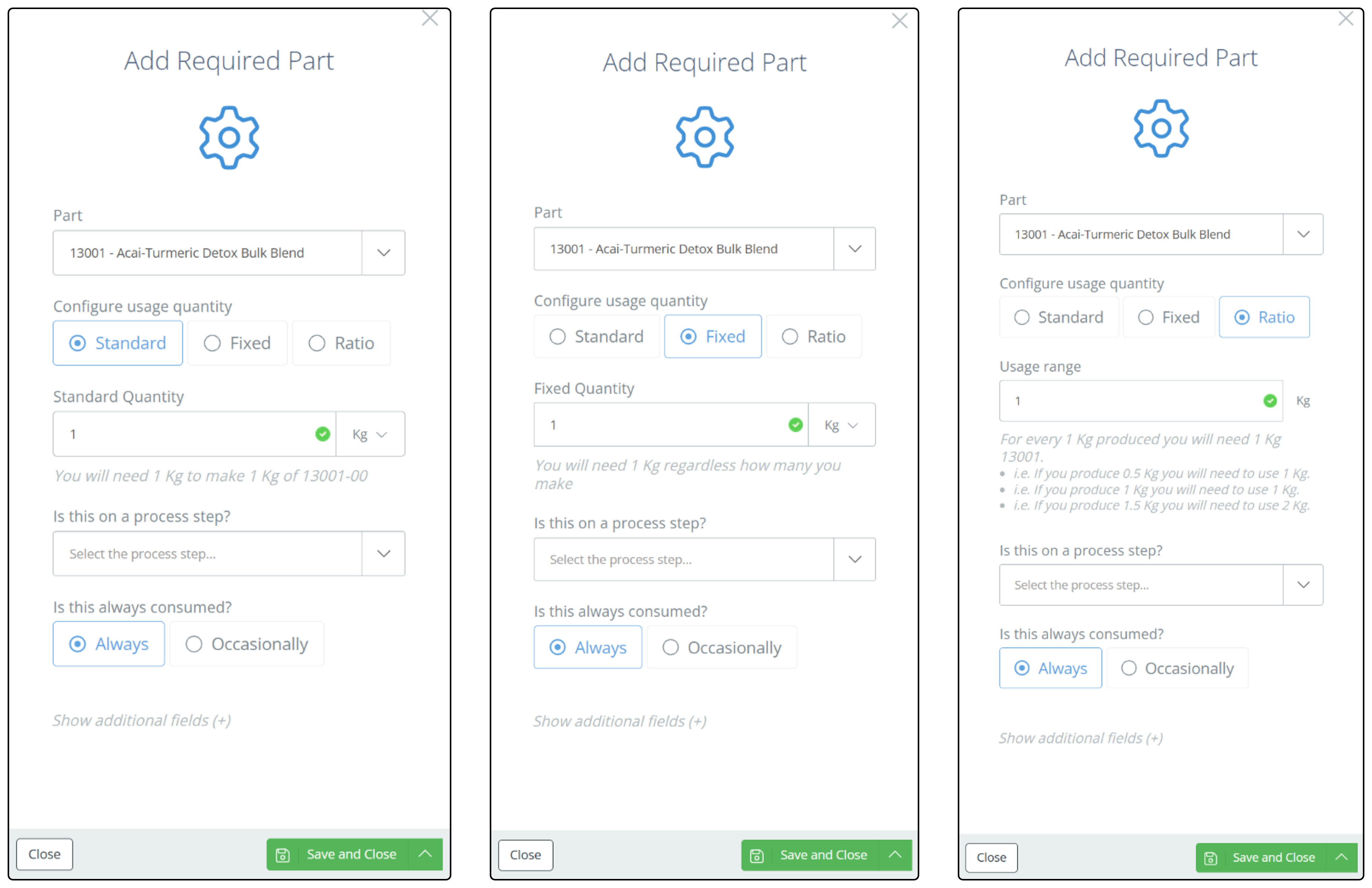
Choose a usage quantity- 'Standard' is the most common, as the consumed quantity will directly scale up and down automatically based on the batch size. 'Fixed' means that the consumed quantity stays the same regardless of the scheduled batch size, and 'Ratio' will scale (rounded to the next highest whole number) based on the scheduled batch size.
Standard Quantity means how much of the required part needs to be consumed to make 1 of the finished good. Take special note of the unit of measure (UOM) for both the required part and the finished good. In the example below, this means that 1kg of part 13001 (UOM = kg) is needed to produce 1kg of the finished good, part 13001-00 (UOM = kg). The required part and the finished good do not have to have the same UOM.
If you have process steps set up you can link the consumption of the part to the process step, just select it from the dropdown. Now mark if the part will always be consumed, or occasionally. If marked as 'Occasionally' the part will be considered an 'Optional' part, and the manufacturing record can be signed without it ever being consumed, with no escalation. If you have interchangeable parts that can be consumed, see the Optional Required Parts Rules page for information on how to set those up.
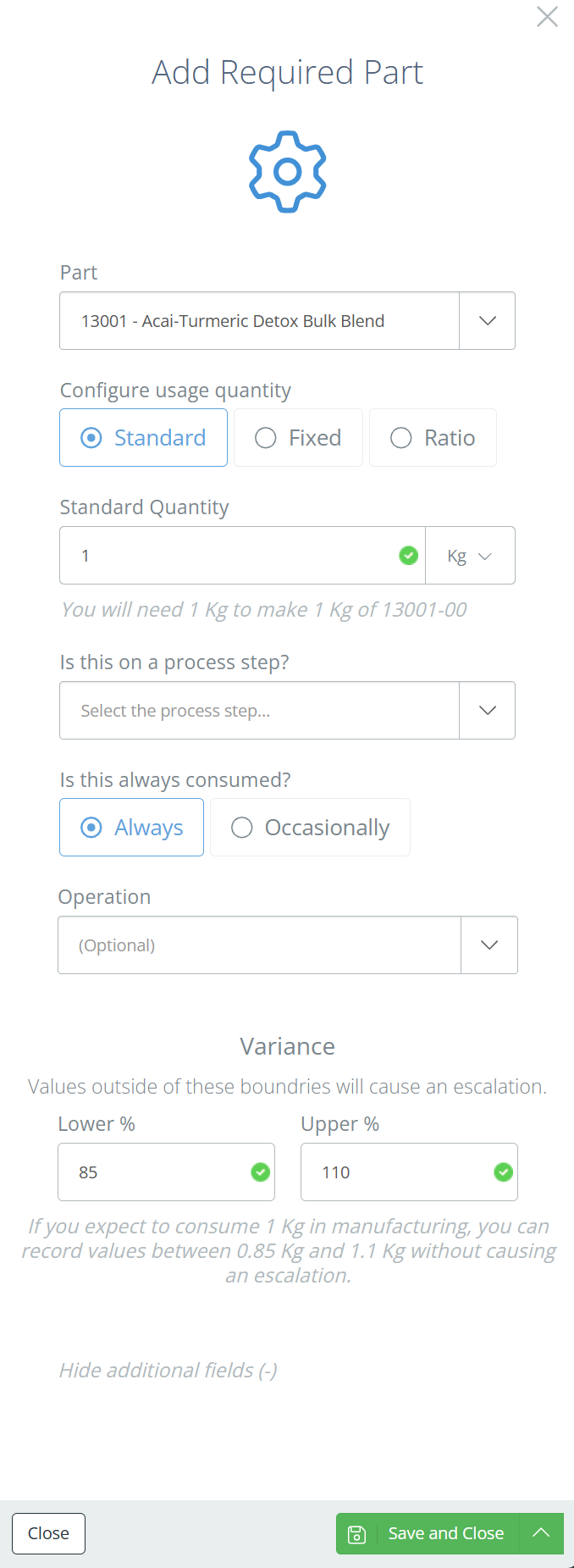
Expanding the 'Show additional fields (+)' section will allow you to associate the part with a specific operation, and set consumption variance limits. If the amount of this part consumed during manufacturing is less than the Lower boundary, or higher than the Upper boundary, an escalation will occur.
Once the parts have been added, you still adjust consumption settings for the parts by clicking 'Edit' in the Actions column. See the Edit Required Parts section below for more details.
Via 'Quick Add Required Parts'
This option is helpful when you have a large number of parts to add to the BOM, with no special requirements.
Once you click 'Quick Add Required Parts', a new aside will open. Select each of the parts that will be consumed during manufacturing, and their standard quantity. Click 'Save' when done.
Standard Quantity means how much of the required part needs to be consumed to make 1 of the finished good. Take special note of the unit of measure (UOM) for both the required part and the finished good. In the example below, this means that 1kg of part 13001 (UOM = kg) and 5ea of part 14000 (UOM = ea) is needed to produce 1kg of the finished good, part 13001-00 (UOM = kg). The required parts and the finished good do not have to have the same UOM.
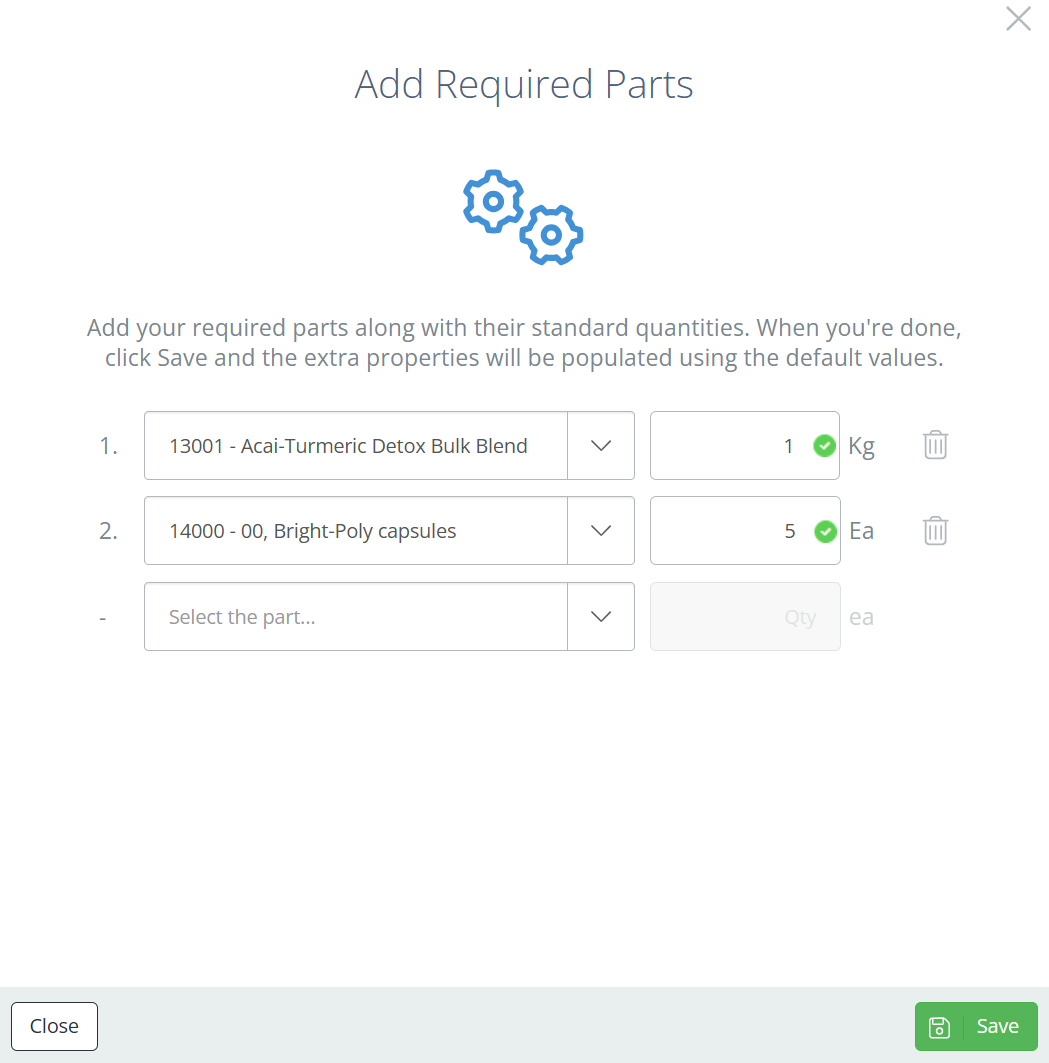
Once the parts have been added, you can adjust consumption settings for the parts by clicking 'Edit' in the Actions column. See the Edit Required Parts section below for more details.
Via 'Add Required Parts Using Percentages'
This option is best used for percent-type ingredients (ex. 1 part rice to 2 parts water). Package-type parts should not be added here, as those are consumed by the whole number, never a decimal.
Once you click 'Add Required Parts Using Percentages', a new aside will open. Select each of the parts that will be consumed during manufacturing, and their percentage of the final product. The percentages of all added parts must be equal to 100%. Click 'Save' when done.
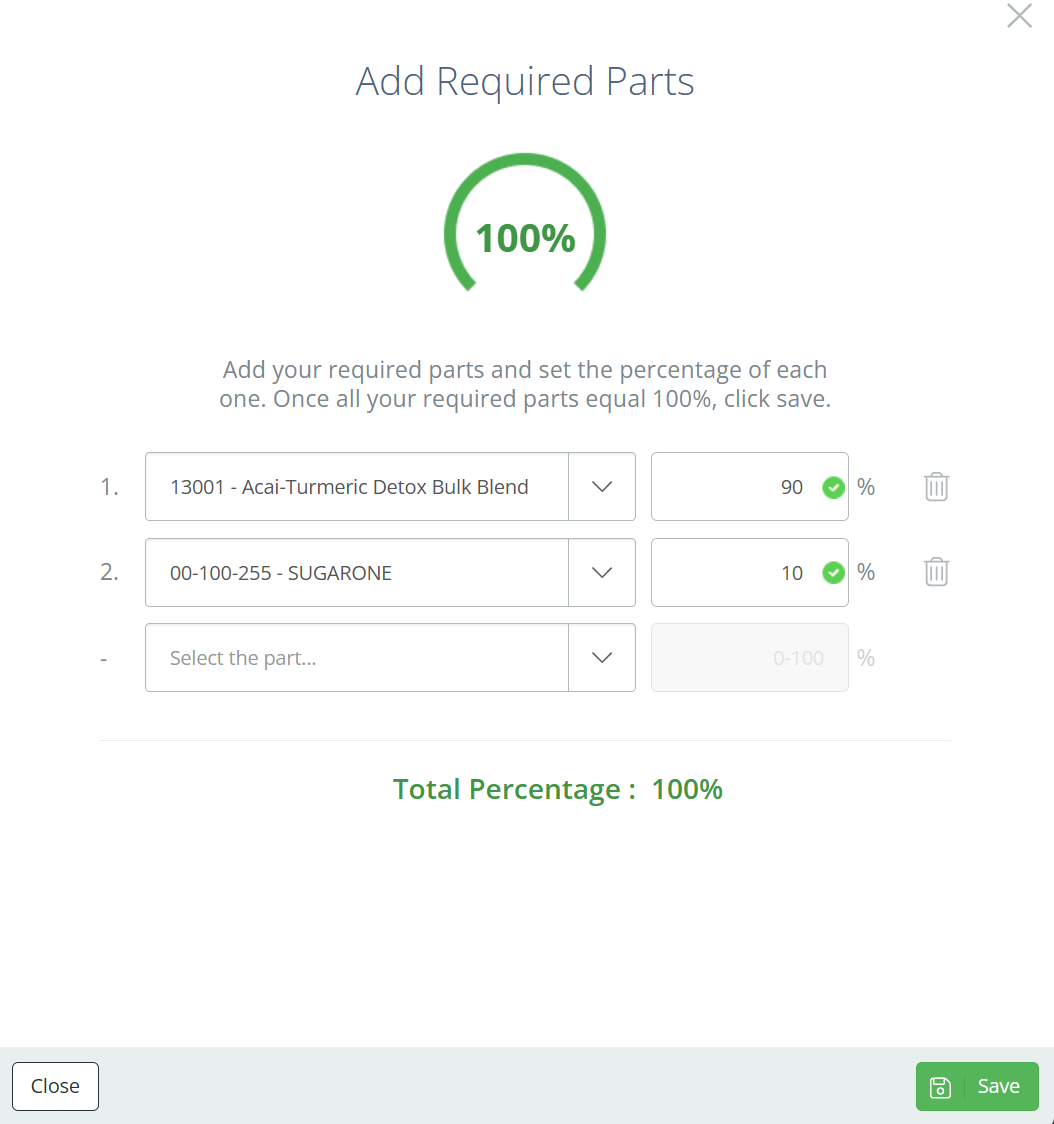
DataNinja will automatically calculate how much of each part is required to create 1 qty of the produced part, and assign the Standard Quantity accordingly.
Standard Quantity means how much of the required part needs to be consumed to make 1 of the finished good. Take special note of the unit of measure (UOM) for both the required part and the finished good. In the example above, this means that .9kg of part 13001 (UOM = kg) and .1kg of part 00-100-255 (UOM = kg) is needed to produce 1kg of the finished good, part 13001-00 (UOM = kg). The required parts and the finished good do not have to have the same UOM.
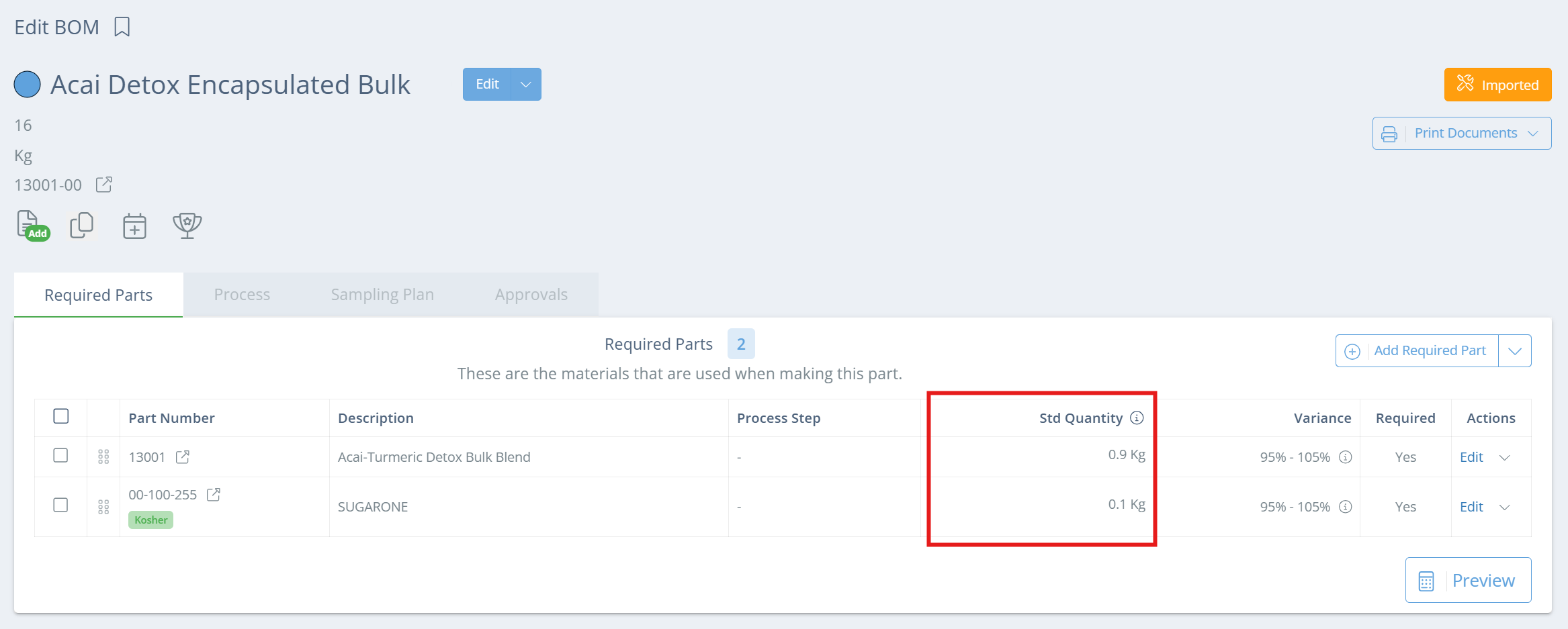
Once the parts have been added, you can adjust consumption settings for the parts by clicking 'Edit' in the Actions column. See the Edit Required Parts section below for more details.
Via 'Add Required Parts From Batch Size'
This option is helpful if you know precise quantities for each consumed part, but for a larger batch size (greater than 1) of the finished good.
Once you click 'Add Required Parts From Batch Size', a new aside will open. Specify how much of the finished good will be created, then list the consumed parts and their quantities. Click 'Save' when done.
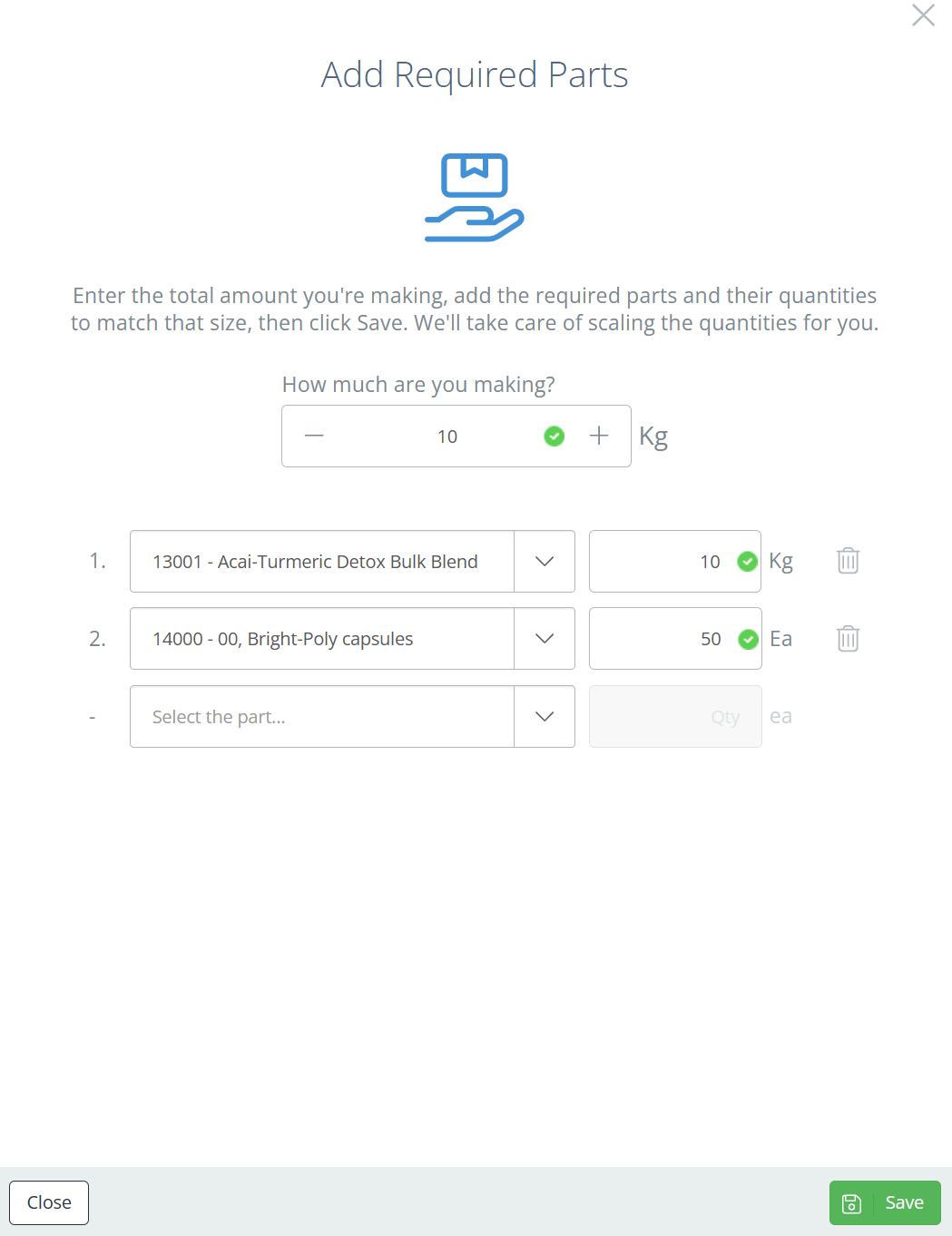
DataNinja will then automatically calculate the Standard Quantity of each required part.
Standard Quantity means how much of the required part needs to be consumed to make 1 of the finished good. Take special note of the unit of measure (UOM) for both the required part and the finished good. In the example above, this means that 1kg of part 13001 (UOM = kg) and 5ea of part 14000 (UOM = ea) is needed to produce 1kg of the finished good, part 13001-00 (UOM = kg). The required parts and the finished good do not have to have the same UOM.
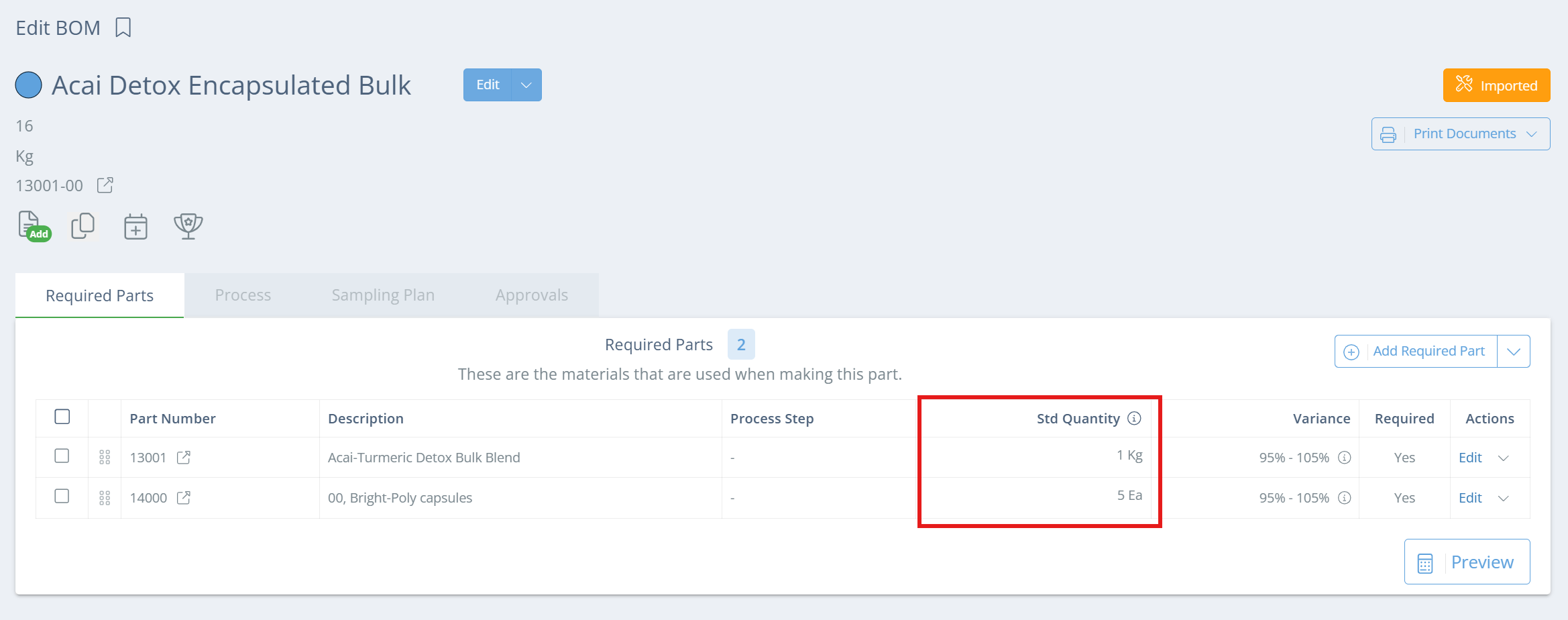
Once the parts have been added, you can adjust consumption settings for the parts by clicking 'Edit' in the Actions column. See the Edit Required Parts section below for more details.
Edit Required Parts
To edit the consumption settings for a required part, click 'Edit' in the Actions column on the Edit BOM page.
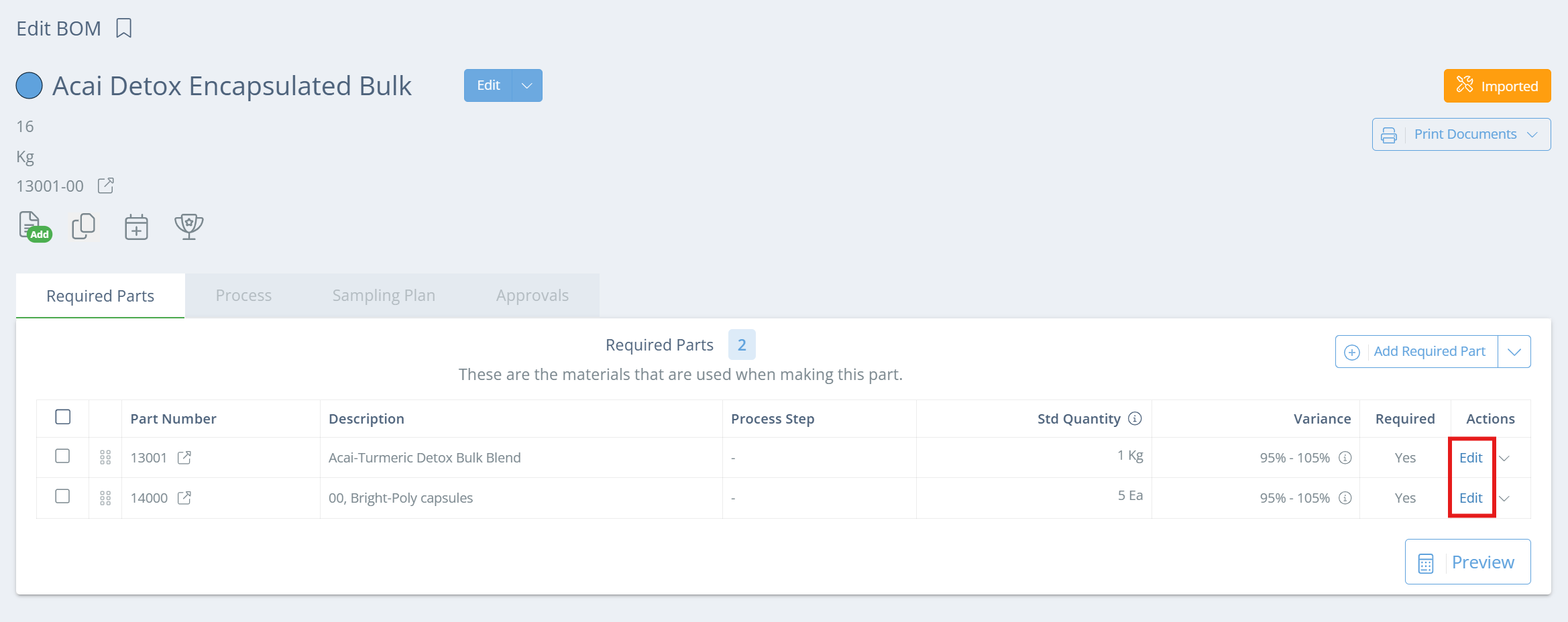
In the new aside, you can adjust the usage quantity, linked process step, change it from a required part to an optional part (consumed occasionally = optional part), linked operation, and change the variance range.
Usage Quantity
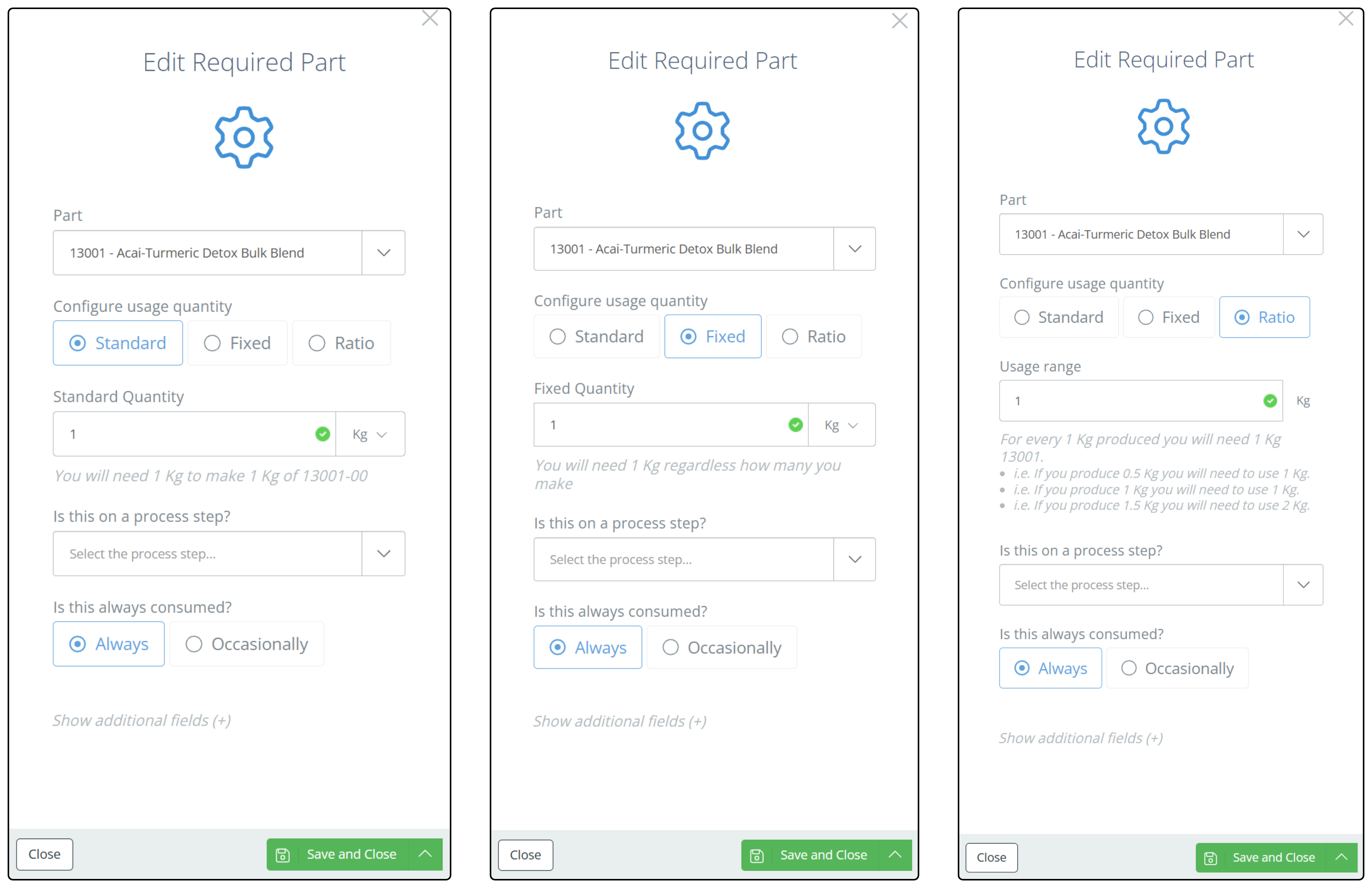
'Standard' is the most common, as the consumed quantity will directly scale up and down automatically based on the batch size. 'Fixed' means that the consumed quantity stays the same regardless of the scheduled batch size, and 'Ratio' will scale (rounded to the next highest whole number) based on the scheduled batch size.
Standard Quantity means how much of the required part needs to be consumed to make 1 of the finished good. Take special note of the unit of measure (UOM) for both the required part and the finished good. In the example below, this means that 1kg of part 13001 (UOM = kg) is needed to produce 1kg of the finished good, part 13001-00 (UOM = kg). The required part and the finished good do not have to have the same UOM.
Process Step
If you have process steps set up you can link the consumption of the part to the process step, just select it from the dropdown.
Required vs Optional
Now mark if the part will always be consumed, or occasionally. If marked as 'Occasionally' the part will be considered an 'Optional' part, and the manufacturing record can be signed without it ever being consumed, with no escalation. If you have interchangeable parts that can be consumed, see the Optional Required Parts Rules page for information on how to set those up.
Operation and Variance Range
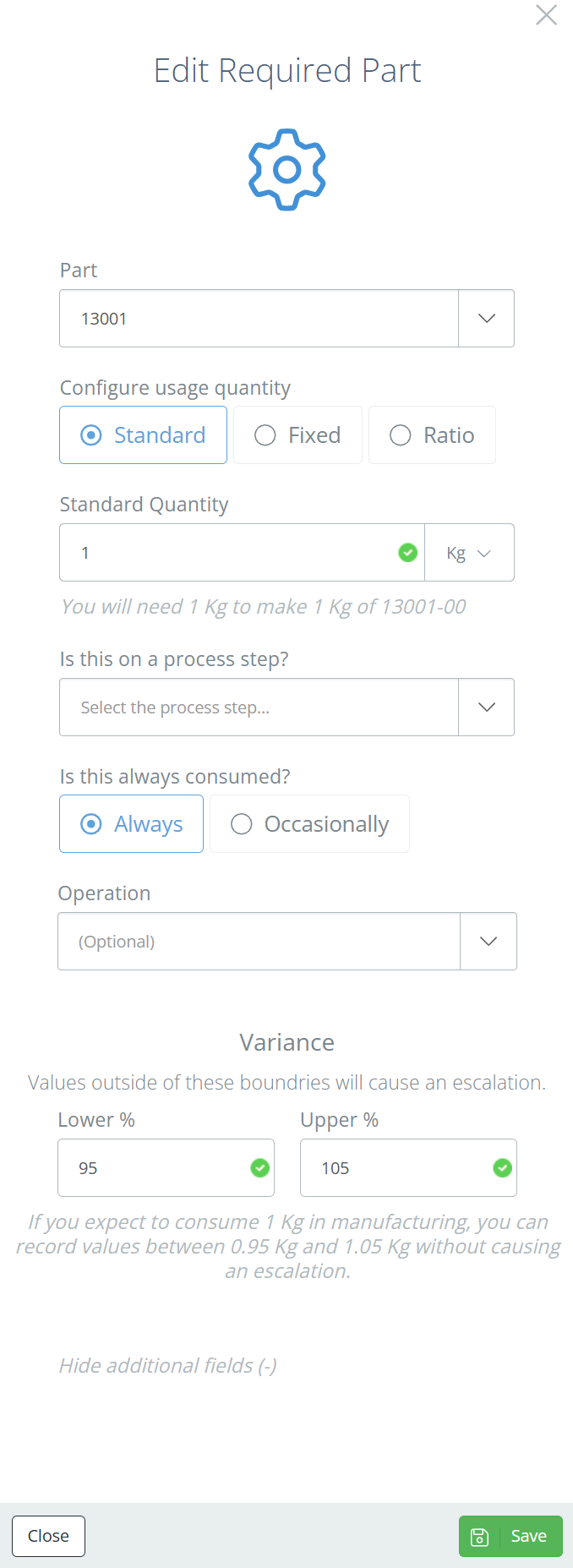
Expanding the 'Show additional fields (+)' section will allow you to associate the part with a specific operation, and set consumption variance limits. If the amount of this part consumed during manufacturing is less than the Lower boundary, or higher than the Upper boundary, an escalation will occur.
Updated 10 days ago